‘Bullying’ Says Everything and Nothing at the Same Time
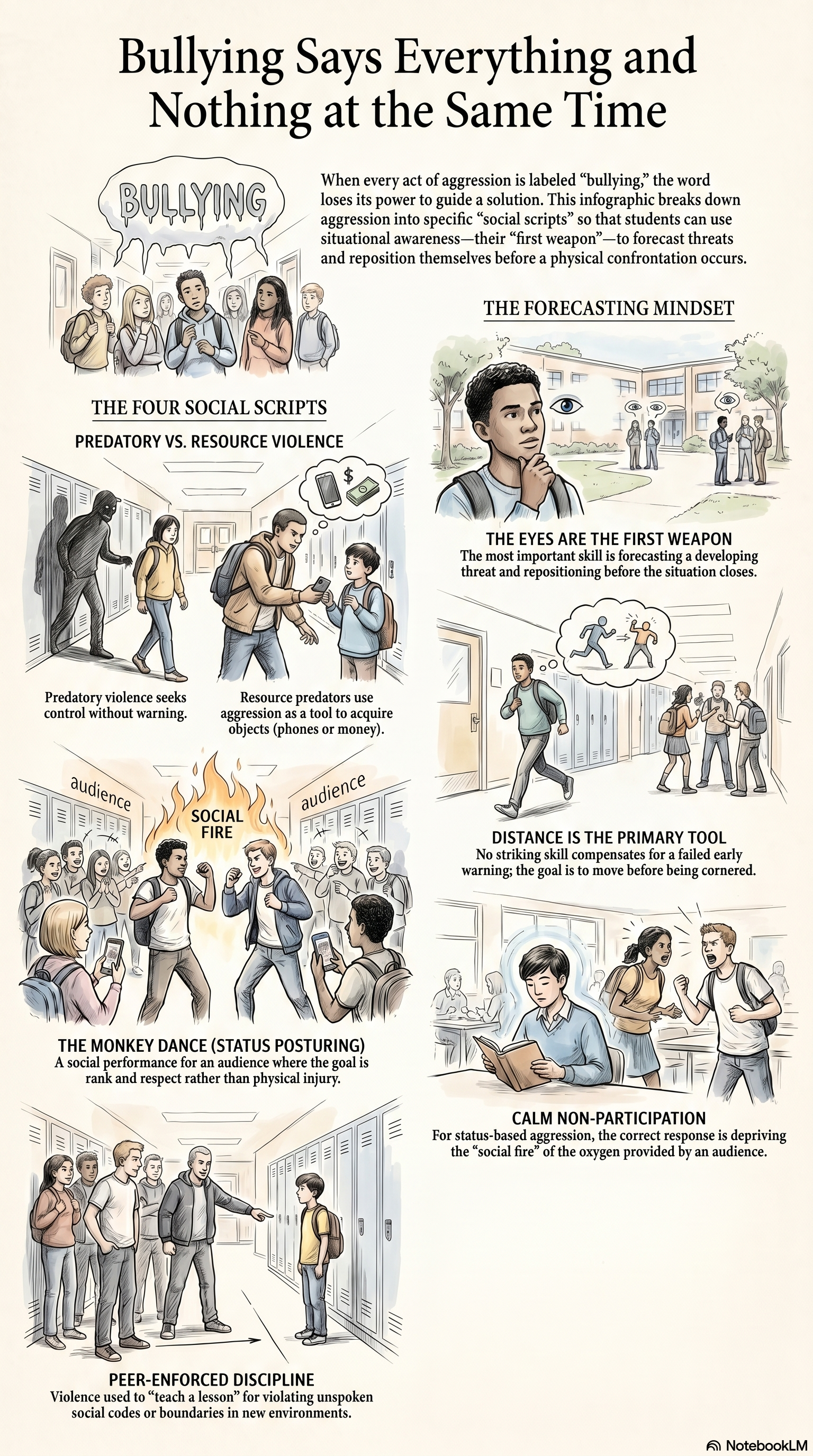
We have a word for it. When a child comes home upset, when a teacher files a report, when a parent calls the school — there is always a word ready. Bullying. It is the label we reach for whenever one young person causes harm to another, and it does its job well enough in those moments. It names the event. It assigns blame. It gives everyone in the room a shared vocabulary.
“Because “bullying” tells us nothing about what actually happened…It collapses every possible form of aggression into a single word — and then leaves the child standing in the middle of it, knowing what to call the situation but having no idea what to do about it.”
What it doesn’t give us is a plan.
Because “bullying” tells us nothing about what actually happened. It doesn’t tell us whether the aggressor wanted to hurt your child or wanted their lunch money. It doesn’t tell us whether the violence was impulsive or premeditated, public or private, social or predatory. It doesn’t tell us whether your child was targeted specifically or was simply in the wrong place at the wrong time. It collapses every possible form of aggression into a single word — and then leaves the child standing in the middle of it, knowing what to call the situation but having no idea what to do about it.
So we do what feels logical. We sign them up for self-defense. We find a martial arts class. We teach them to fight.
And that instinct is not wrong — but it is incomplete. Fighting is the emergency answer. It is what you reach for when every other option has already been exhausted, when distance has collapsed and escape is gone and there is nothing left between you and the threat. It is necessary to know. But it is the hardest answer, the slowest to develop, and for children whose bodies are still years away from physical maturity, it is also the answer least available to them in the moments they need most.
We have been handing children the tool of last resort and calling it preparation.
“So we do what feels logical. We sign them up for self-defense. We find a martial arts class. We teach them to fight.
And that instinct is not wrong — but it is incomple”
The Forecasting Mindset
Before we can talk about what to do, we need to establish what the first weapon actually is — and it isn’t a fist. It’s the eyes.
The most important skill in personal safety is the ability to forecast. To see a situation developing before it closes. To read the room, identify what’s forming, and reposition before the moment of danger arrives. This is not a physical skill. It does not require size, strength, or years of training. It is available to a seven-year-old right now, today — and it is the single most effective tool we can put in a child’s hands.
Distance is what the eyes protect. Every form of aggression requires proximity to work. A threat that cannot reach your child cannot harm your child. Managing distance — staying out of range, moving early, removing yourself from the equation before the situation closes — is the foundation everything else is built on. No striking skill compensates for a failed early warning. The goal is always to move before being cornered, not after.
This is why we train the eyes before we train the hands.
The Four Social Scripts
Here is what “bullying” has been hiding. Aggression between young people does not come in one form — it comes in four, each with its own logic, its own warning signs, and its own appropriate response. We call these the four social scripts, because each one follows a recognizable pattern. And a child who can read the script has options that a child who can only fight does not.
Predatory Violence
“predatory violence most often exploits the very things we teach children to do: be polite, comply with adults, don’t cause a scene. ”
The aggressor wants you — not your possessions, not social approval. Their goal may be harm, control, or worse. There is no performance, no warning display, no escalating argument. They have chosen their target, chosen their moment, and they are operating with deliberate intent. This is the wolf — and it does not announce itself.
For children ages 7–12, predatory violence most often exploits the very things we teach children to do: be polite, comply with adults, don’t cause a scene. Predators use conditioned compliance as an access point — offering help, using authority, creating isolation. The script here is designed to be invisible until it’s too late.
The response is simple and must be immediate: be early. The moment something feels wrong, the awareness window is open. The moment that window closes — when a child is grabbed, cornered, or isolated — the easiest options are already gone. Trust the feeling. Create distance. Move now, not after confirmation.
Resource Predators
The aggressor doesn’t want you — they want what you have. A phone, lunch money, a backpack. But they are willing to behave like a predator to get it. Think coyote, not wolf. Still dangerous, still deliberate — but more deterrable, and more likely to move on if the target looks difficult.
The key insight for children is that this is a calculation, not a tantrum. The resource predator is looking for the easiest available target. A child who is attentive, moving with purpose, and not isolated is a harder target. Compliance doesn’t guarantee safety, and early awareness remains the primary tool — because the same rule applies: distance managed early is distance that protects.
The Monkey Dance — Status Posturing
“The oxygen here is the audience — the witnesses who make the performance meaningful. A child who engages feeds the fire. A child who shows fear feeds the fire.”
This is aggression as social performance. The aggressor isn’t primarily trying to hurt anyone — they are performing for an audience, seeking validation, approval, or rank within a peer group. The real target is not the victim. It is the crowd watching.
This is the social fire. And like any fire, it needs oxygen to burn. The oxygen here is the audience — the witnesses who make the performance meaningful. A child who engages feeds the fire. A child who shows fear feeds the fire. The correct response is calm non-participation and, wherever possible, physical removal from the audience. Deprive the social fire of its oxygen and the performance loses its purpose.
For children ages 7–12, this is the most common form of peer aggression they will encounter. It is also the most misread — because it looks like violence but is fundamentally a social problem requiring a social response, not a physical one.
Peer-Enforced Discipline
“A child who walks into a new space and reads it first — who defers to whom, what the unspoken hierarchies are, where the invisible lines run — is far less likely to unknowingly cross one.”
Violence used by a person or group to communicate that an unspoken rule has been broken. The aggressor believes they are teaching a lesson. This might be gang territory, a school social hierarchy, a group code, or a boundary that was never explained to the person who crossed it.
What makes this script particularly dangerous for children is that the rule is invisible until it’s violated. A new school, a new neighbourhood, a new social environment — all carry codes that aren’t posted anywhere. Wearing the wrong colours, sitting in the wrong seat, befriending the wrong person — any of these can trigger a response that feels completely disproportionate, because the child had no idea a line existed.
The response here is situational awareness before entry. Know the environment before you’re in it. Observe before you participate. A child who walks into a new space and reads it first — who defers to whom, what the unspoken hierarchies are, where the invisible lines run — is far less likely to unknowingly cross one.
What Comes Next
Each of these four scripts demands something different. Two of them — predatory violence and resource predation — are solved primarily by distance and early awareness. One of them — the monkey dance — is a social problem that physical force will only escalate. And one of them — peer-enforced discipline — is prevented by observation before it ever begins.
Notice how rarely the answer is fighting. Not because fighting doesn’t matter — it does — but because most of what our children actually face can be resolved well before that level is reached. If they know what they’re looking at.
In the next piece, we will walk through the framework we use in class to build exactly that capability: five layers of response — avoid, run, hide, talk, and fight — ordered not by preference but by cost. Fighting sits at the top because it is the most dangerous and most physically demanding option available. Everything below it is faster, safer, and more accessible to a child right now, regardless of size or strength.
But it all begins with the eyes. And the eyes, fortunately, are already open.