The Hierarchy of Personal Safety: The Options Before the Fight
In Part 1, I walked through the four social scripts hiding underneath the word “bullying” — and why each one demands a different response. Now I want to show what that response actually looks like. The following is the framework we use in class.
A Hierarchy of Cost
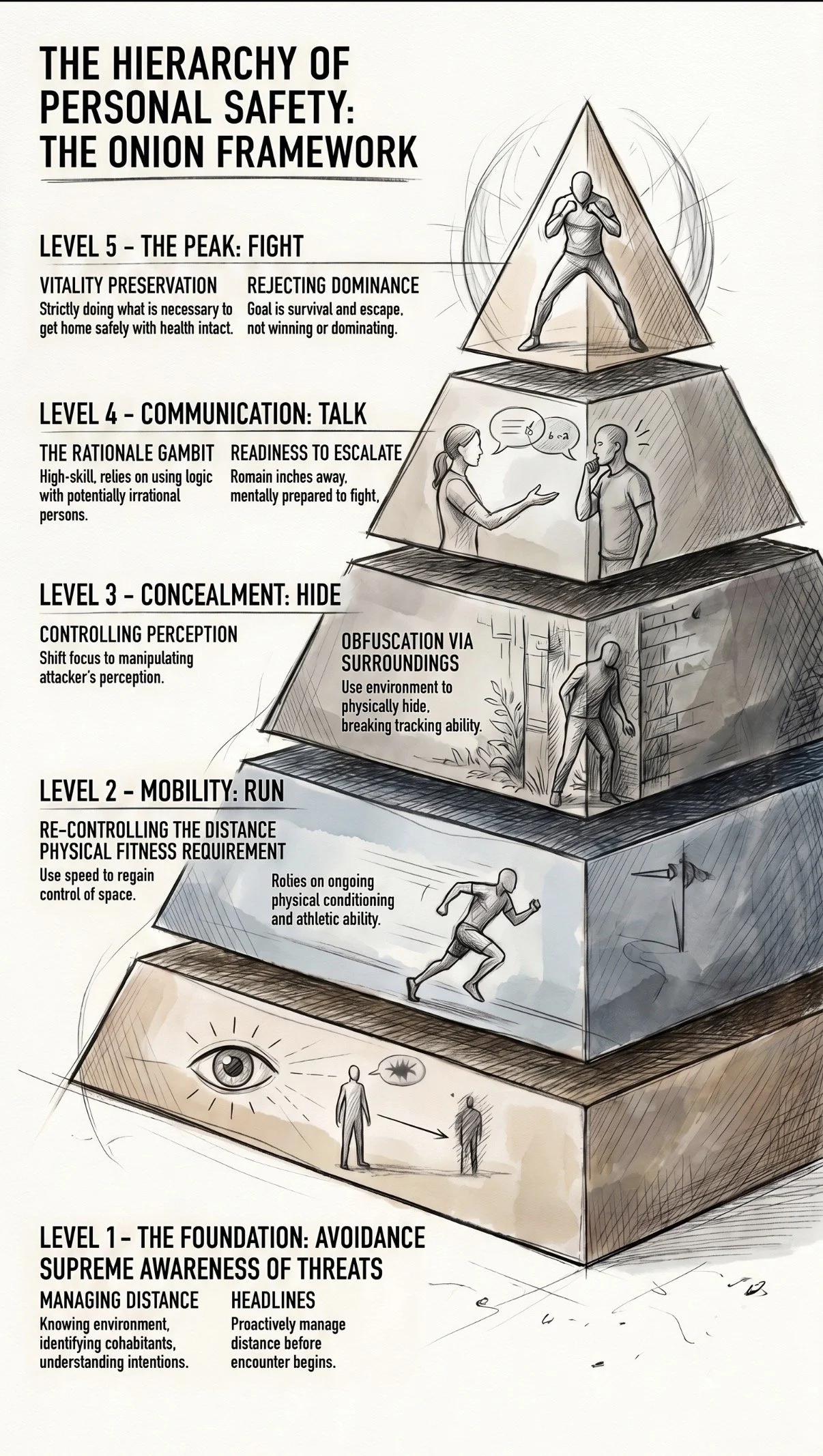
I teach my students to think about personal safety as a pyramid. At its base is avoidance. At its peak is fighting. And the fundamental premise of everything in between is this: the higher you climb, the closer you are to serious injury.
“The goal is always to solve the problem as low on the pyramid as possible, as early as possible.”
It is better to avoid than to run. Better to run than to hide. Better to hide than to talk. Better to talk than to fight. And better to fight than to die.
I don’t present this as a checklist to work through calmly. I present it as a hierarchy of cost. Every level upward represents a failure to resolve the situation at the level below — and a corresponding increase in danger. The goal is always to solve the problem as low on the pyramid as possible, as early as possible.
What connects every level is the same variable I kept coming back to in Part 1: distance. Managing distance is managing safety. Every layer of this framework is ultimately about controlling how close a threat can get to your child. A failure to manage distance is a step toward the worst possible outcome — and each level of the pyramid is a tool for recovering it before that outcome arrives.
This is also why I invest so much training time in the lower levels. The higher levels of this pyramid are the ones that depend most on physical capacity — a body that is still years from maturity. The lower levels depend on awareness, decision-making, and instinct — faculties that are fully available to your child right now. When I work with 7 to 12 year olds, I am not waiting for their bodies to catch up. I am building the skills that are already ready to be built.
Level 1 — The Foundation: Avoidance
This is where I spend the most time with young students, and it is the least physical thing we do together.
Avoidance is built on two things: knowing your environment and reading the people in it. Who is here. How they are behaving. What feels out of place. What the distance between your child and a potential threat currently is — and whether it is closing. I teach this through what I call reading headlines — training students to pick up the early signals that something is developing before it develops fully.
Here is what I tell my students: you already know how to feel when something is wrong. You have felt it. That instinct is real and it is accurate. What I am teaching you is to treat that feeling as a green light — not to investigate, not to confirm, not to wait and see. To move. To create distance. To remove yourself from the equation before the situation closes around you.
Children are remarkably sensitive to their environment. They feel shifts in energy, changes in attention, the moment a space stops feeling safe. They just haven’t always been given permission to act on those feelings without proof. I give them that permission. Because against the two most dangerous threats from Part 1 — predatory violence and resource predation — early movement is the primary defense. Both depend on access. Both depend on proximity. A threat that cannot reach your child cannot harm your child.
“Children are remarkably sensitive to their environment. They feel shifts in energy, changes in attention, the moment a space stops feeling safe.”
Most dangerous situations are resolved here, at the foundation, before they ever become dangerous. If the eyes are open and the instincts are trusted.
Level 2 — Mobility: Run
The second level assumes the threat has already closed some distance. Avoidance was not enough — or the signal came too late — and now the body needs to perform.
I teach my students that running is not weakness. It is the tactically correct decision. It is the fastest, safest, most reliable way to resolve a dangerous situation available to them — and it works at every age, at every size, against almost every threat. The goal of everything I teach is to get home safely. Running accomplishes that goal better than anything above it on this pyramid.
“A child who cannot run hard for two minutes has a gap in their safety toolkit that no striking technique can fill. This is something I am direct about with my students. Sedentary habits narrow options. Movement keeps them open.”
But running requires the body to be ready. This is why fitness is not a separate conversation from self-defense in my classes — it is the same conversation. The ability to move with speed and urgency, to put meaningful distance between your child and a threat in the seconds that matter, is a physical capacity that has to be developed before it is needed. I am not asking for athletic excellence. I am asking that your child’s body is conditioned enough to respond when the signal comes.
A child who cannot run hard for two minutes has a gap in their safety toolkit that no striking technique can fill. This is something I am direct about with my students. Sedentary habits narrow options. Movement keeps them open.
Level 3 — Concealment: Hide
The third level assumes that running is no longer available. The threat is too close, the environment too confined, or the distance already gone. Now I teach students to use their environment as a tool.
If an aggressor cannot find your child, they cannot reach your child. I teach concealment as the intelligent use of surroundings — breaking line of sight, using cover, disappearing into a space in a way that makes your child unavailable to be tracked. A child who has been taught to see their environment as something to be used has options that a child who only knows how to fight does not.
I also point out to my students that something important shifts at this level. Up to this point, everything has been about your body and its position. At Level 3, the primary variable becomes what the attacker can perceive. That is a different kind of problem — and it requires a different kind of intelligence. It is one that punching harder will never solve.
Level 4 — Communication: Talk
“most of the violence that actually happens between young people is social in nature — driven by insecurity, jealousy, status, and the need for peer validation.”
I want to be direct with you about something: most of the violence that actually happens between young people never reaches the physical levels of this pyramid at all. It lives here, at Level 4. It is social in nature — driven by insecurity, jealousy, status, and the need for peer validation. It is the monkey dance and peer-enforced discipline from Part 1. It is fueled by words before it ever becomes physical, and it is a social problem that requires a social solution.
I teach two things at this level. The first is what I call the rationale gambit — using calm, logical communication to de-escalate a situation with a person who may not be entirely rational in that moment. I am honest with my students that this is a high-skill tool. It is difficult. It requires reading another person accurately, choosing words that lower the temperature rather than raise it, and maintaining composure under real social pressure. It does not come naturally, and it takes practice.
The second thing I teach is readiness to escalate — and this is the part that most people overlook. I teach my students that talking from a position of genuine physical preparedness is fundamentally different from talking out of fear. When you are calm, close enough to act, and mentally prepared to move if the conversation fails — you communicate differently. Your body language is different. Your voice is different. The other person usually feels it. Talking is not the absence of fighting readiness. It is fighting readiness expressed through words first.
For the monkey dance specifically, I teach my students one response above all others: calm non-participation. Don’t engage. Don’t show fear. Don’t perform for the audience. Simply decline to be a participant in someone else’s social script. Deprive the social fire of its oxygen, and the performance loses its purpose.
Level 5 — The Peak: Fight
When every other level has failed — when distance has collapsed, concealment is impossible, communication has not worked, and the threat is immediate and physical — I teach my students to fight. But I teach them to fight with a very specific goal in mind.
Not victory. Not dominance. Survival and exit.
I tell my students: the goal is to get home with your health intact. Nothing more. The moment an exit becomes available, you take it. You are not there to win. You are there to survive long enough to leave. I am deliberate about this framing because young people are often taught — implicitly, by culture, by peers — that fighting means winning. In my gym, fighting means getting home.
“When we reduce self-defense to fighting, we remove all of those options from the conversation. We hand children the hardest, slowest, most physically demanding tool on the pyramid — and we skip the four layers beneath it that are faster, safer, and far more appropriate for where they are developmentally.”
I am also honest about what fighting requires, because I think we deserve to hear it plainly. It is the slowest skill on this entire pyramid to develop. Reaching genuine competence — where technique is available under stress, without consciously retrieving it — takes years of serious, consistent training. This is why I teach Muay Thai, and why I recommend wrestling, Brazilian Jiu-Jitsu, and boxing alongside it. These are combative arts built on live resistance training from early in the learning process. They close the gap between knowing a technique and being able to use it under pressure faster than any other approach. There is very little theory. The application is immediate. That matters when time is the most expensive variable.
But I always remind our students — and I want to remind us parents — Despite the time it takes, there are much more effective options available to you at all times that can make fighting unnecessary to wait until maturity to develop.
These options are the most important thing I want you to take from this framework. Most of them are available to our child right now, without a single punch being thrown.
When we reduce self-defense to fighting, we remove all of those options from the conversation. We hand children the hardest, slowest, most physically demanding tool on the pyramid — and we skip the four layers beneath it that are faster, safer, and far more appropriate for where they are developmentally. A child who can read a room, trust their instincts, move when the signal comes, use their environment intelligently, and communicate under pressure — that child is prepared. Not because they can fight, but because in most situations, they won’t have to.
What we are building in our young students is not a fighter. It is a person who sees clearly, thinks under pressure, and has a range of options available to them before the situation ever reaches the level that fighting is required.
And here is why this work matters right now, at the age your child is today. Everything I have described — every social script, every level of this pyramid — converges in high school. That is where status posturing reaches its peak intensity, where peer boundaries carry real consequences, where resource predation increases, and where for the first time genuine predatory threats become a statistical reality. High school is where all of it arrives at once, at full volume, with the least adult supervision your child will ever have had.
But what your child is experiencing at ages 7 to 12 is not a different world. It is the same world at a lower dose. The monkey dance on the playground is the same social script they will face at 16 — just with smaller stakes and more room to learn from it. The moment a space feels wrong, the peer pressure to conform, the unspoken codes of a new group — these are not previews of real life. They are real life, early, when the cost of a mistake is still manageable.
We should not wait for our child to be big enough to defend themselves. Let’s use the time we have right now — when the doses are low and the lessons are available — to build the habits, instincts, and judgment they will need when the stakes are not.
High school will come. I want them ready before it does.
Thank you for investing in their growth.
Yours in the Arts, Kru Yai Nick Bautista