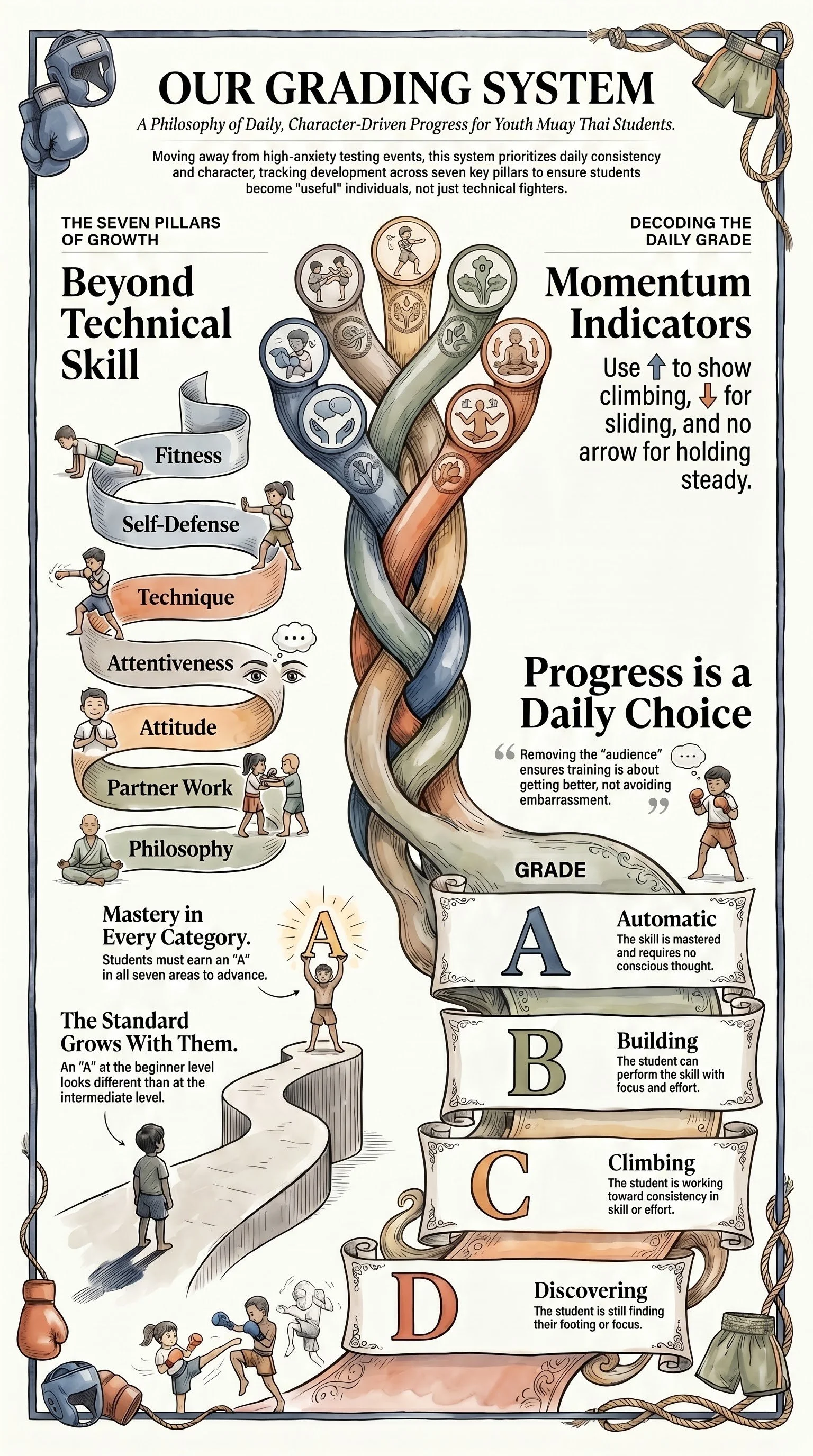
Our Grading System
I did martial arts my whole life. And at every school, every program, there was always a grading.
It was an event. Tickets sold. An audience. A performance. And somewhere along the way, that event stopped being about getting better and started being about not embarrassing yourself in public. I remember training not because I loved it — but because I was afraid of what would happen if I didn’t show up ready when the day came.
I hated it as a kid. It intercepted everything. The thing I loved became the thing I was anxious about.
Youth programs should develop passion alongside skill — and the two should feed each other. As skill grows, passion deepens. As passion grows, skill follows. Pull them apart and you lose both.
That’s why I grade differently.
I take the audience out entirely. I remove the performance. There are no gradings, no ceremonies, no tickets sold. Grading happens daily — because performance is a daily choice, and consistency matters far more than rising to a single occasion.
We grade seven areas of development:
Fitness, Self Defence, Muay Thai Technique, Attentiveness, Attitude, Partner Work, and Philosophy.
The content of each category changes as your child advances. What earns an A in Fitness at a beginner level looks different than what earns an A at an intermediate level. The standard grows with them.
The grading system has four levels:
A — Automatic. The skill is there. They don’t have to think about it anymore.
B — Building. They can do it, but it takes focus and effort.
C — Climbing. Still working toward consistency — either with the skill itself, or with the effort it takes to apply it.
D — Discovering. Still finding their footing — with the skill, or with their focus today.
Each grade can carry an arrow — ↑ means they’re climbing, ↓ means they’re sliding. No arrow means they’re holding steady.
To advance to the next level, a student must earn an A in every category.
Not most of them. All of them.
This is intentional. Muay Thai is the vehicle, but it is not the whole journey. What we have built around it — the fitness, the self defence, the partner work, the philosophy — is a complete system designed to develop your child into someone useful. Useful to themselves, useful to their team, useful to their community. Technical skill matters. So does character. So does the ability to think, to show up for others, and to keep going when it gets hard. Every category is in the system because every category reflects something we believe your child needs.
What this means for your child
On a good day, they’ll come home and tell you they got a B↑ in Attitude. That’s worth celebrating.
On a harder day, they might come home with a C in Attentiveness. They know what that means — it’s on the wall. They were climbing. That’s worth a conversation, not a punishment.
The goal is never to shame. The goal is to make progress visible so your child learns to track their own development, take ownership of their effort, and understand that growth is a daily choice — not something that happens to them at the end of a term.
That’s the lesson underneath all the other lessons.
Questions are always welcome. Pls dont hesitate to inquire about your child’s progress :)