Mental Warfare: Daughters Edition
Sport fighting is not real fighting. It resembles fighting and is the strongest image of it, so it’s natural to draw the conclusion that learning a combat sport is what teaches our kids to defend themselves. This is partially true at best.
Sport is not a perfect preparation for real life violence. It’s a good start but does not suffice.
Because our understanding of violence tends to be physical, we rarely stop and consider the mental warfare that precedes the physical violence — or even the violence that stays mental, that leads to the erosion of a child’s confidence and vigour. Much of the violence that goes unnoticed is the mental kind. Not just the physical kind that makes the news.
This is especially true for our daughters.
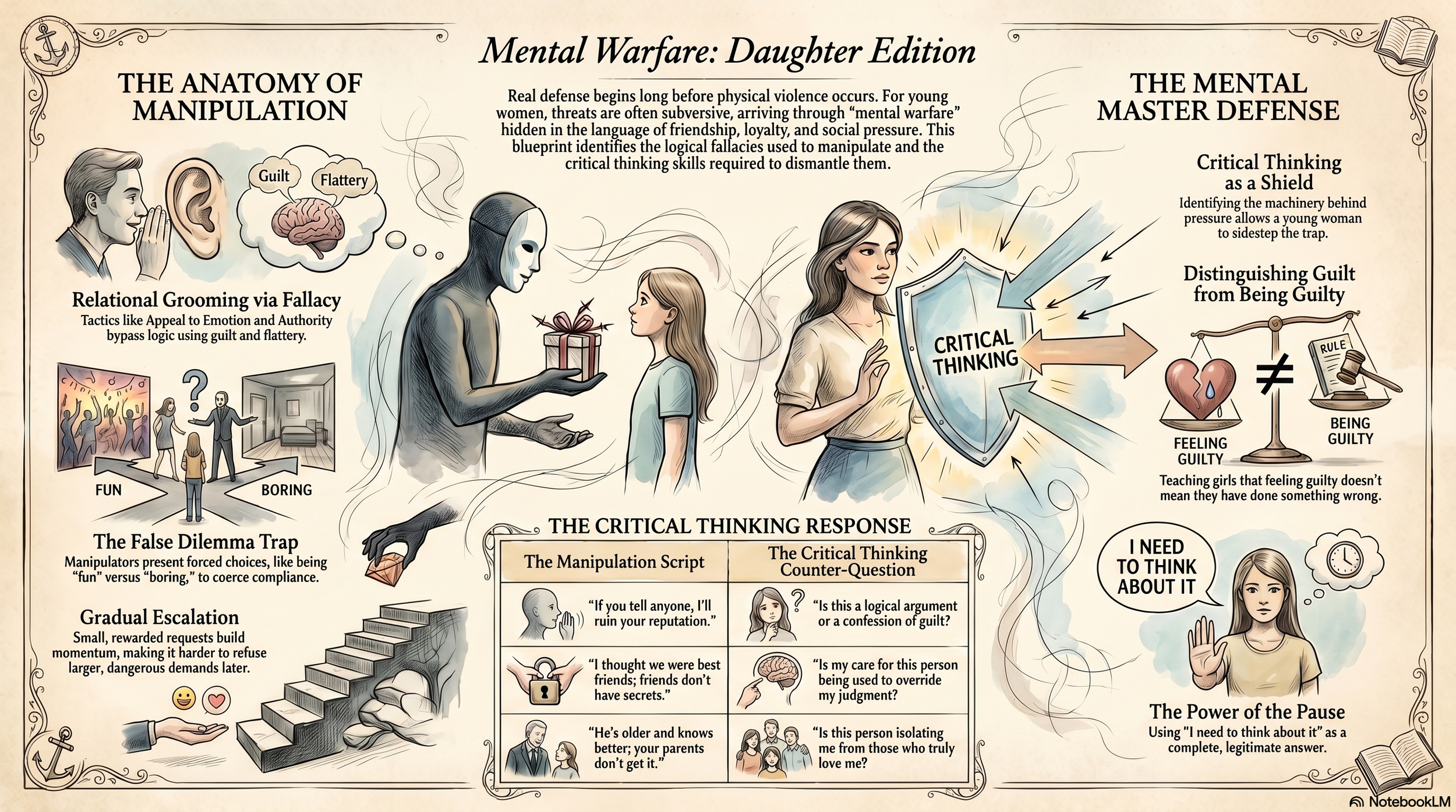
Violence is the most intimate subject we can teach our children, so it is important that we hit the mark and arm their minds as much as we arm their bodies. For girls, that means being honest about what the threats actually look like — because they rarely look like a stranger. They look like a friend, a boyfriend, a group chat, a slow build of pressure from someone she already trusts.
Though there are instances of stranger danger and sudden unprovoked attacks, many of the daily attacks our daughters face are verbal. Subversive. Chronic. And then one day they explode physically. Avoidance doesn’t happen at the physical level — it happens much earlier. It happens in the moment the manipulation first arrives. That is where I focus this curriculum. If a young woman can recognize that her thinking is being targeted, she can sidestep the entire chain of events before it ever becomes something we can see with our eyes.
“For girls, that means being honest about what the threats actually look like — because they rarely look like a stranger. They look like a friend, a boyfriend, a group chat, a slow build of pressure from someone she already trusts.”
This is where critical thinking becomes critical. It is an age old discipline — one built specifically for exposing erroneous thinking that motivates the wrong actions. It arms the mind and strengthens its ability to identify when it is being influenced. A young woman who thinks critically is not just smarter — she is harder to manipulate. She makes better decisions because she can see the machinery behind the pressure before she responds to it.
For girls, the manipulation that needs to be avoided is specific. It is more relational, more gradual, and more personal than what boys typically face. It comes wrapped in the language of love, friendship, and loyalty — which makes it harder to identify and harder to refuse without feeling like you are doing something wrong.
Here is what it actually looks like.
Appeal to Emotion
Before any other manipulation can work, the aggressor has to bypass rational thinking by triggering a strong feeling. For girls this trigger is most often relational — guilt about not being a good enough friend, fear of losing the relationship, or the warm pull of feeling chosen and understood. It rarely arrives as a threat. It arrives as a feeling that she is failing someone she cares about.
It sounds like:
“I thought we were best friends — best friends don’t keep secrets from each other.”
“He really likes you, don’t you want him to feel good about himself?”
“You’re so sensitive, I was just joking — why do you always make things weird.”
The counter is to distinguish between feeling guilty and being guilty. I teach girls that these are not the same thing. When a strong emotion arrives alongside pressure to act, the question to ask is: “Is my care for this person being used to override my judgment?”Genuine relationships do not require you to abandon your instincts to prove your loyalty.
Appeal to Authority
For girls this attack most frequently arrives through an older male — a boyfriend, an older peer, or an adult in a position of trust — who positions himself as uniquely qualified to understand her. The authority is almost always paired with flattery. She is told she is mature for her age, special, different from other girls. This combination of elevated status and personal flattery is one of the primary patterns of grooming and it is important to name it plainly.
It sounds like:
“He’s older and more experienced, he knows what he’s talking about.”
“Your parents just don’t understand — he gets you in a way they never will.”
“He said you’re not like other girls, you’re mature enough to handle this.” “Your friends are just jealous, they don’t know him like you do.”
The counter is to recognize the pattern rather than evaluate each piece of it individually.
Our daughters should ask:
“Is this person positioning themselves as the only one who understands me while moving me away from everyone else who loves me?”
Flattery combined with isolation is not a relationship. It is a warning sign. Any adult who requires secrecy from a young person’s parents has already told you everything you need to know.
Appeal to Popularity
Appeal to Popularity is most frequently tied to appearance, sexual behaviour, and social media. The pressure is not just to act a certain way but to look and present a certain way — and the implied consequence of refusing is being seen as immature, prudish, or insecure. The standard is constantly being reset by people who benefit from her feeling like she is falling short of it.
“The standard is constantly being reset by people who benefit from her feeling like she is falling short of it.”
It sounds like: “All girls our age send photos like that, it’s totally normal.” “Everyone has done something with a guy by now, it’s not a big deal.” “Girls who don’t dress like this just don’t have confidence.” “Every girl on social media looks like this.”
The counter is to examine who is setting the standard and why. I teach girls to ask: “Was this norm created by someone who has my best interests at heart — or by someone who benefits from my compliance?” Trends, peer behaviour, and social media are never neutral. Someone profits from the standard being set. Knowing that changes how you measure yourself against it.
False Dilemma
For girls the false choice is most often built around identity and loyalty rather than sides in a conflict. The two options presented are a version of acceptable female behaviour versus a damaging label — and the labels used carry particular social weight. The attack is designed to make refusal feel like a character flaw rather than a reasonable decision.
It sounds like:
“You either trust me or you don’t — which is it?”
“You can come with us and be fun or stay home and be boring.”
“Girls who say no to this are just scared or immature.”
“You’re either the kind of girl who is cool about things or you’re not.”
The counter is to refuse the label along with the choice. I teach girls that their decision about one situation does not define who they are as a person. A label applied under pressure is a tool, not a truth. The question to ask is: “Am I being handed a label to make me feel like I have no choice?” Seeing it for what it is dissolves most of its power immediately.
Ad Hominem
For girls this attack most frequently takes the form of a reputation threat — used both to silence and to coerce. It is the specific threat that her social and sexual reputation will be damaged if she speaks up, refuses, or tells someone. This weaponizes the social consequences that girls face more acutely than boys and it is designed to make compliance feel safer than resistance.
It sounds like:
“If you tell anyone I’ll make sure everyone knows what you did.”
“Nobody will believe you anyway — everyone knows what you’re like.”
“Girls who act like that get a reputation — is that what you want?”
The counter is to recognize a reputation threat for what it actually is — evidence that the person making it knows they are doing something wrong. I teach girls clearly: the fact that someone might lie about you is never a reason to comply with them. It is a reason to tell a trusted adult immediately. A threat to your reputation is not a logical argument. It is a confession.
The Pattern Underneath All of It — Gradual Escalation
Beyond the individual attacks there is one pattern I teach girls to recognize above all others. Manipulation rarely arrives all at once. It builds. A small request. Compliance is rewarded with affection or inclusion. The next request is slightly larger. And refusal at any point is met with “but you already did this, so why not that?”
I teach girls that every decision stands alone. What she agreed to yesterday does not obligate her today. The question that cuts through the entire pattern is this: “Would I agree to this if I had never agreed to anything before?” If the answer is no — the history is being used as a trap, not a reason.
The master defence underneath everything is the same. These attacks rely on speed and momentum. The most powerful thing a young woman can do is pause before she complies. Teaching your daughter that “I’m not comfortable with that” and “I need to think about it” are always complete and legitimate answers — and practising those words at home before she ever needs them — may be one of the most protective things you ever do for her.
To the parents reading this — stay close enough that she brings it to you when something feels wrong, even before she can explain why. Her instincts are an asset. Her boundaries are legitimate. No relationship worth having will ever require her to override either.
See you soon,
Kru Yai Nick