Mental Warfare: Youth edition
Sport fighting is not real fighting. It resembles fighting and is the strongest image of it, so it’s natural to draw the conclusion that learning a combat sport is what teaches our kids to defend themselves. This is partially true at best.
Sport is not a perfect preparation for real life violence. It’s a good start but does not suffice.
Because our understanding of violence tends to be physical, we rarely stop and consider the mental warfare that precedes the physical violence — or even the violence that stays mental, that leads to the erosion of a child’s confidence and vigour. Much of the violence that goes unnoticed is the mental kind. Not just the physical kind that makes the news.
“Though there are instances of stranger danger and sudden unprovoked attacks, many of the daily attacks our children face are verbal. Subversive. Chronic.”
Violence is the most intimate subject we can teach our children, so it is important that we hit the mark and arm their minds as much as we arm their bodies. The following is our effort towards critical thinking — teaching our children to recognize the mental warfare that happens to them without their knowing, and how to defend against it.
Though there are instances of stranger danger and sudden unprovoked attacks, many of the daily attacks our children face are verbal. Subversive. Chronic. And then one day they explode physically. Avoidance doesn’t happen at the physical level — it happens much earlier. It happens in the moment the manipulation first arrives. If a young person can recognize that their thinking is being targeted, they can sidestep the entire chain of events before it ever becomes something we can see with our eyes.
This is where critical thinking becomes critical. It is an age old discipline — one built specifically for exposing erroneous thinking that motivates the wrong actions. It arms the mind and strengthens its ability to identify when it is being influenced. A young person who thinks critically is not just smarter — they are harder to manipulate. They make better decisions because they can see the machinery behind the pressure before they respond to it.
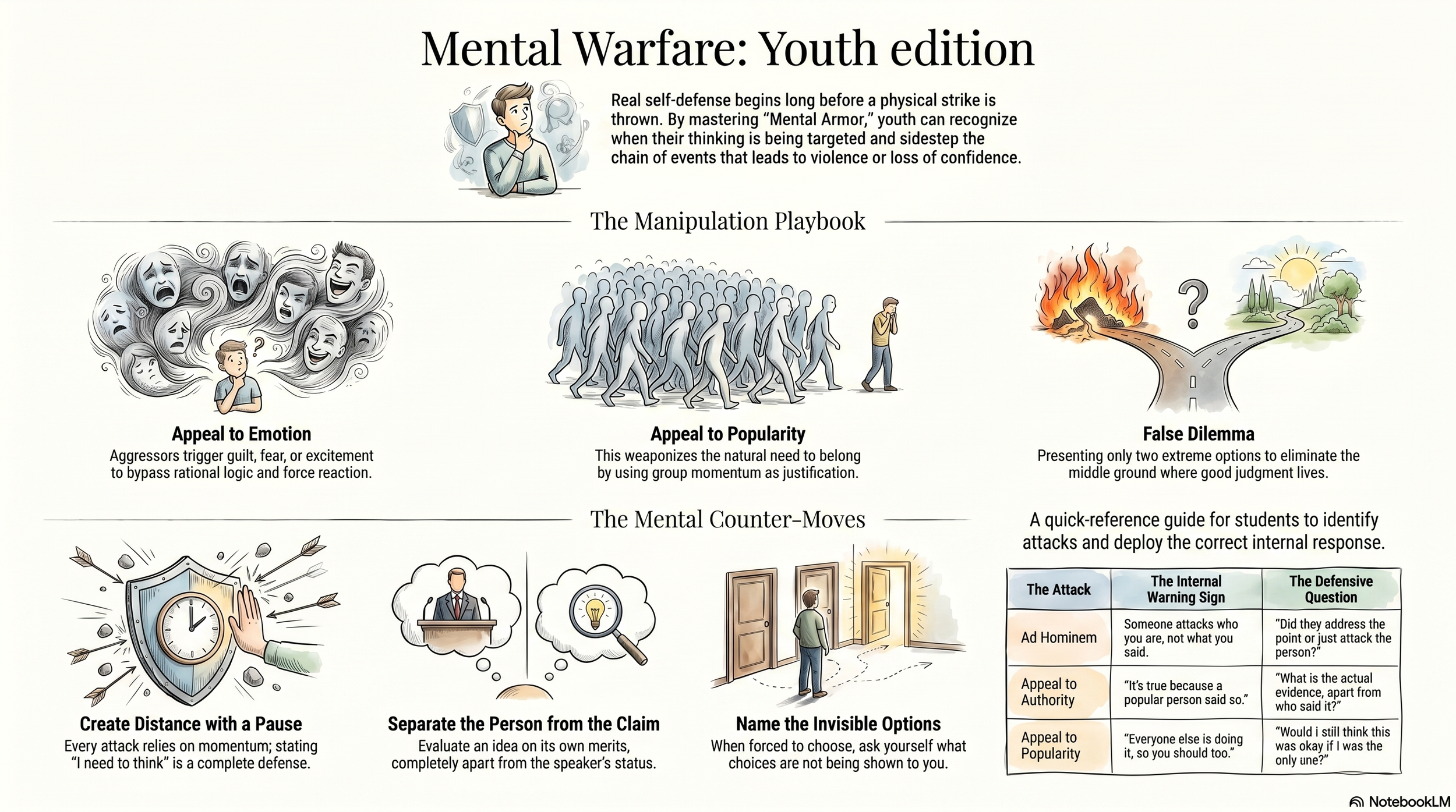
I teach five specific manipulation tactics — intellectual attacks — and a trained counter-response for each one.
Appeal to Emotion
This is the delivery system for almost all other manipulation. Before any other attack can work, the aggressor has to bypass rational thinking by triggering a strong feeling — guilt, fear, excitement, or the need to belong. Once the emotion is activated, thinking stops and reacting begins. This is the door that lets every other attack in.
It sounds like:
“I thought you were my real friend.”
“Everyone will think you’re a coward if you don’t.”
“Don’t you want to be part of this?”
The counter is to treat a sudden strong emotion in a pressure situation as a warning light, not a green light. I teach students that the more urgently they feel they must decide right now, the more important it is to slow down. The question to ask is simple: “Am I being made to feel something so that I stop thinking something?” That one question creates enough distance to let the mind back in.
Appeal to Authority
This is the claim that something must be true or acceptable because someone influential said so — a popular peer, an older student, or a social media figure with a large following. It works by substituting status for evidence. The person’s position or popularity is presented as the reason to comply, and questioning it feels like questioning them personally.
It sounds like:
“This grade 9 told me vaping is totally safe, they do it all the time.”
“My favourite TikToker says this works and they have two million followers.”
“The most popular kid said that new student is weird so I’m avoiding them.”
The counter is to separate the person from the claim entirely. I teach students to ask: “What is the actual evidence for this — completely apart from who said it?” A respected person can still be wrong. Popularity and truth are not the same thing. The idea deserves to stand or fall on its own merits, not on the reputation of whoever delivered it.
Appeal to Popularity
This is the argument that something must be acceptable because a majority of people are doing it. It is one of the most dangerous attacks for young people specifically because it weaponizes the very natural and healthy need to belong. It turns the fear of exclusion into a decision making tool, and it works fastest in group situations where momentum is already building.
It sounds like:
“Everyone’s sending that photo around, it’s no big deal if I forward it too.”
“All my friends left that kid out of the group chat so I didn’t invite them either.”
“Everybody cheats on this teacher’s tests, it’s basically expected.”
The counter is a private judgment made before the group’s momentum sets in. I teach students to ask themselves quietly: “Would I still think this was okay if I was the only one doing it?” If the answer is no — the group is the justification, not the logic. A majority has been catastrophically wrong throughout all of human history. Numbers are not proof.
False Dilemma
This attack presents only two options when more exist — forcing a choice under pressure and eliminating the middle ground where good judgment lives. It is designed to make hesitation feel impossible and refusal feel like a declaration of war. The pressure to decide immediately is not accidental. It is part of the attack.
It sounds like:
“You’re either on our side or you’re on theirs — choose.”
“If you don’t send me that picture you don’t actually like me.”
“If you tell a teacher you’re a snitch. If you don’t, you’re just letting it happen.”
The counter is to look for the option that isn’t being offered. I teach students to ask: “What choice am I not being shown here?” and “Who benefits from me believing these are my only two options?” There is almost always a third path. The goal of this attack is to make that path invisible — naming it out loud makes it real again.
Ad Hominem
This attack dismisses what someone says by targeting who they are rather than addressing what they actually said. It is used in two directions — to shut down someone who is speaking an uncomfortable truth, and to make our students feel that their own voice doesn’t count. In both cases the point being made is never actually addressed. That is the tell.
It sounds like:
“Don’t listen to him, he’s such a loser.”
“She would say that, she’s so stuck up.”
“Nobody cares what you think.” “Of course you’d say that.”
The counter is to separate the argument from the person making it — in both directions. I teach students to ask: “Did they actually address what was said — or just attack who said it?” A person’s social standing has no bearing on whether their point is valid. And when this attack is turned on the student themselves — their idea still deserves to be evaluated on its own merits, regardless of what anyone thinks of them personally.
The Master Defence
Every one of these attacks relies on speed and momentum. The single most powerful thing a young person can do is pause before they comply. In physical self-defence we call that creating distance. You cannot counter what you haven’t given yourself space to see. Teaching our children that “I need to think about it” is always a complete and legitimate answer may be one of the most protective things we’ll ever do for them.
See you soon,
Kru Yai Nick Bautista